
A young man who had attempted an aptitude test I conducted lamented bitterly to me following the completion of the test. The allotted thirty minutes had passed in a flash and even though he thought he was progressing quite nicely, he couldn’t quite reach the end. You see, in these tests, there are no time warnings. You are simply told you’ve got 30 minutes, told to start and then 30 minutes later, a loud bellowing voice announces “stop”. Pretty much that’s it! If you did not do a good job at managing your own time, it would’ve happily breeze past you.
“Who can finish this test then?” he quipped. I’m sure a lot of you have the same question, and my answer will be “you…yes YOU can finish the test”. But to do so, you cannot rely on conventional examination methods.
In my last article, I already touched on the importance of practice and what practice methods you can adopt to improve your speed and accuracy. Today, I will be touching on some of the common pitfalls people fall into when preparing for or taking their tests. These little pitfalls can also contribute to slowing you down hence the need to be aware of them and get them sorted. Let’s get right to it shall we?
Of Calculators and Adding Machines
Your numerical aptitude tests may or may not require the use of calculators. First check what is allowed. But if they do permit the use of calculators, here are a few points to think about:
More often than not, the calculators required are simple adding machines. I’ve seen a lot of candidates come to the test with complex scientific calculators as though some genius software running on them could produce the answers once pointed at the questions. As I mentioned in my earlier post on this subject, punching on calculators already presents a potential time waster. Added to this are the other potential problems one could experience while using calculators more complex than required. I once had a candidate who didn’t know how to put on his super-duper calculator, and another whose internet enabled calculator was giving him wrong answers because it was in some kind of different mode he didn’t quite understand (I couldn’t help because…you guessed it…I didn’t understand it either). And you can imagine how much time wastage this would cause on a test that requires speed.
Using your phone as a calculator is a no no! It’s likely the test administrators wouldn’t allow it anyways, but even if they did, your phones are notorious distractors. Low batteries, instant messaging, calendar notifications, and even phone calls while taking a test? You can do without that for a few minutes I’m quite sure and concentrate on getting the test done and out of the way. Find yourself a calculator that does nothing else but calculate. You’re less likely to have any issues with that one.
Test your calculator before the big day. Use the same calculator you used to practice so there are no surprises. I know it sounds like an obvious thing to say, but calculators run on batteries and batteries can fail. It’s best to get this sorted and make sure your calculator works before the test, so that a failed calculator does not destabilize you, leaving you gasping for air on account of lost time
You might not believe this, but your best calculator might just be a combination of your brain, your pencil and a plain sheet of paper. Practice using this method and you will get used to certain number sequences that will make answering calculation questions much easier and faster.
The folly of guessing
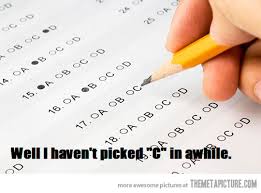
Picture this…you’re taking your career defining aptitude test. You’ve got to finish fifty questions, in thirty minutes. You feel like you’re doing okay when you suddenly notice you’re at the 29 minute 30 second mark and question number 35 is still rattling you. You’ve got 15 questions to go before you can get to the end of the test. What do you do?
From experience and sadly too, a lot of people guess from this point. And they don’t just guess, they make patterned guesses because they want to increase their chances of getting some right. For example, in the scenario above, the person answers option A for all 15 questions remaining. He or she is probably more likely to get more answers correct out of the 15 guesses compared to arbitrary guessing, but what this does is that it makes the guessing obvious.
So what if the guessing is obvious? A correct answer is a correct answer right? Not quite. Often on these aptitude tests, you are advised to avoid guessing and rightfully so. Identifiable patterned guesses are typically eliminated and deducted from your final score, so at the end your guessing adds no value. If you must guess at all, take a cursory look at the question and pick an answer option that looks (even just at face value) most likely. Get as far as you can and stave off the pressure to guess. Remember, there’s no obligation for you to finish the test.
Exam fever
Many have experienced the feeling. You’re all charged up for the test, floating like a butterfly, ready to sting like a bee…and all of a sudden, your stomach churns and an earthquake goes off in your head. You start to sweat profusely as your heart pounds like an African konga. You’ve caught the bug of the exam fever and it’s not very forgiving! Exam fever is usually brought about by anxiety, often shows up unawares and will quickly destabilize the sufferer. So what can you do to avoid it? Here are my thoughts:
- Prepare well ahead of time for your test. The name of the game is preparation. If you fail to prepare, prepare to fail.
- Get good quality rest especially the day before your test. Most people prepare late into the night and do not get any sleep at all. Your brain functions are revived and reenergized when you sleep. Not getting adequate sleep actually is a disservice to yourself and opens you up to greater chance of catching the exam fever.
- Keep a positive attitude regarding the test. Consider that it’s not a do or die affair. While it will be great to pass the test, the world will not grind to a halt if you don’t. However, this shouldn’t be a disincentive to prepare properly. You should aim to make a good showing of yourself.
So far we have touched on what you need to know about aptitude tests, why they are important, what they actually assess and how you can prepare for them. I have also shown you a few tips and tricks that can possibly help you improve your speed and accuracy when taking one of these tests, as well as certain pitfalls to avoid which can affect your speed. So that exhausts the series on tests, for now.
Next time, I will begin the discussion on the next phase of the classic recruitment process – The Interview. In this series, I will share many tips and give ample advice on how to approach many common interview questions. You wouldn’t want to miss it.
Thanks to everyone following this series. Share your stories and personal experiences with me on twitter @dejiogunnubi and on my blog dejiogunnubi.com.
All the best!
Deji Ogunnubi

 In my words...