
So far I’ve shared with you the different parts of the recruitment process leading up to this point. Starting from how you prepare your CV up until how you prepare for and take recruitment aptitude tests. The typical next step in the process is an interview. The interview is an interesting component of the recruitment process because while some processes may not require a test of any kind, virtually all recruitment exercises will require an interview of some sort. Yes I know that in some settings where nepotism holds sway, people can get employment offers without even as much as having written a CV, but let’s assume for a moment that we’re in proper settings, where things work the way they should.
As a recruiter, I particularly loved interviews and as a candidate, I think you should too. Why? Interviews are great opportunities for you to personally and directly market yourself. Until the interview point, you’ve marketed yourself “facelessly”. Your CV and test results have spoken for you and your recruiters have formed a mental picture of what you might be in person. Now’s the time to put a face to all that perception and convince your recruiters that you’re the best man for the job.
Perhaps someone reading this will wonder “…what is the difference between what you’re writing and the barrage of information available on the internet on the same subject?” My take on these issues have always been from a recruiter’s point of view. So I try to share practical information from behind the scenes that many do no know or may not realize. It is my hope that as you are enlightened about these things, it will help you to prepare better and be more successful at recruitment exercises you participate in.
So here are 3 things you might not know about job interviews:
Most interviews are conducted by non-HR people:
Just before you start to hate on HR again, I would have you know that except you are a graduate trainee, the likelihood you will be interviewed by someone outside HR is much higher than being interviewed by an HR professional. Line managers usually want to get a feel for who it is they want to hire and as such are very much invested in the interview process. In my experience, the role of HR in the interview process is more of facilitation than direct involvement or decision-making. Paradoxically, the people who are professionally trained in interviewing skills are HR people!
The regular line manager will likely interview using experience rather than training and you cannot begin to imagine how much unconscious bias can seep through. Your HR interviewer on the other hand will likely focus on making sure that you “check out” with respect to the details you provided in your CV and that you are a fit for the work environment. This means that line managers will likely have a stronger voice in the decision-making at this stage. This is especially true for experienced positions.
What does this mean for you? Simple…be factual with the HR guy, show confidence and humility and you should be fine (provided you’re not seeking to be paid three times the starting salary for your job) but if there’s one guy you must impress, it’s the line manager.
Your interview starts before and goes beyond your “interview”:
Although informal, it is not at all unusual for interviewers to check your public social media profiles – Facebook, Twitter, LinkedIn (and whatever else is in use these days) to get a feel for the kind of person you really are. Professionally, evidence from outside the interview process should not be used in determining interview outcomes, but in reality, what they do is confirm or refute impressions. So if you are that sort of person who changes your relationship status on Facebook to “it’s complicated” every other month, or air your controversial political views on your twitter handle, be aware that these things form part of who you are and may be exploited to get a more rounded view of who you are. Your recruiters might also have armed themselves with this information as they interview you.
Beyond social media, other people who have interacted with you can be informally asked about you. Even the receptionist, or recruitment assistant can be asked about your demeanor while waiting to be called in for your interview. Fidgeting with your documents, going to and fro the toilet, being impolite to others are things that can do you in.
Most interviewers are not trained interviewers:
Yes, that’s the fact, believe it or not. While many HR professionals are trained to interview and reduce the incidence of bias, as most eventual interview decisions are actually taken by line managers, the influence of bias and first impressions is very strong and HR often finds itself contending against these strong human emotions. Science tells us that it takes only about seven seconds to form a first impression. This impression for an untrained person can cloud the entire interview process. You can use this to your advantage by ensuring that you leave off a good first impression, starting from how you appear, to your presentation, speech, and confidence level.
This fact is also why different people use different interview techniques. You will experience some very amiable interviewers who are definitely firing hard questions at you but smiling through it, and then you will experience those who think the way to get the best out of you is to make you uncomfortable.
Next time, we will consider a few more tips that can help you do a better job at your upcoming interviews and hopefully clinch that job. Follow on my blog dejiogunnubi.com and on twitter @deji_ogunnubi.
All the best.
Deji
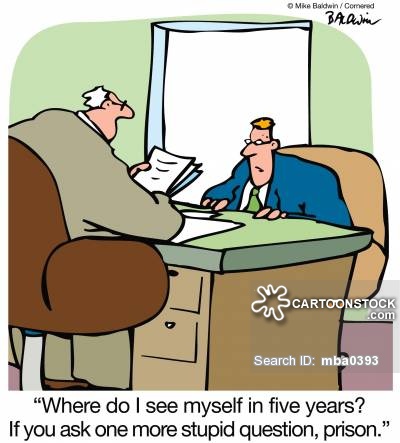
‘Where do I see myself in five years? If you ask one more stupid question, prison.’

 In my words...
Nice job.